
 It's been 13 years since I last saw my sister Suzi and I’m so glad I decided to visit her as part of this journey: we both needed it.
From the moment she met me at Fayetteville Airport on Friday evening until she dropped me back there again on Monday, we didn't stop talking. We had a lifetime worth of stories to remember and years worth of news, thoughts and feelings to catch up on.
I think we both came away with revised perspectives of each other. I’d guess that she is more aware of my vulnerabilities and fears than before. I see her as stronger and more willful than ever before (In fact she told me that her strategy has always been to seem to agree with what she was told, but then to go ahead and do what she wants anyway). She's also more joyful than I've ever seen her: she told me she's always loved to play and (particularly) now that she’s passed the age where she has to be responsible for others, she’s free to indulge in her own childlike joy. She plays with her grandchildren (and always has) and they love her for it. They all have rich stories to tell of spending time with her.
On Sunday Suzi had planned a lovely family reunion-supper and I had a wonderful afternoon getting re-acquainted with 3 of her 4 children: Amy, Eric and Wendy (Sarah and her family live in Texas and couldn't come), as well as Eric's (lovely) fiancé, Melissa, his bright and fabulous daughter, Sammy and Wendy's extraordinary husband Tony and their fantastic daughters Brittney and Brooke. I particularly enjoyed getting to know 9-yr-old Brooke who is bright, curious and intrigued by her (exotic) Australian relatives. We promised to write. It's a promise I intend to keep.
It was wonderful to flesh out the family stories from their perspective: Amy told me that she and Dad used to debate about things: he’d challenge her and she’d go study up on whatever the subject and come back with fresh and informed arguments. They once debated the Communist Manifesto (sounds remarkably similar to my own debates with him over nuclear proliferation). I told her that when I'd made a particularly well-constructed argument that Dad couldn't find holes in (but still didn't agree with) He'd say (smiling mischievously), "That's just dumb-ass, Sandy!" Suzi's kids also told stories about how Mum used to roller skate with them in the driveway.
Suzi and I got quite deep into it on Saturday night and talked late into the night about our childhood memories. We were both quite open about our experiences and feelings growing up. She seemed to feel a little discomfort with the depth of our discussion the next day and I understood that the concern might be based on her uncertainty about how I might use the information I gather on this journey (perhaps because of this blog or how all of this will figure into my thesis). I tried to reassure her that I realise that my perceptions are just that - my perceptions and that I know that my truths are not necessarily everyone's or THE truth. Suzi told me that just as we were falling off to sleep, angels (or something similar) came to her and though their energy seemed a bit confused (or confusing), she felt they were saying that we need to be careful about the stories we pass on: that it’s okay for the two of us to share our mutual stories, but that we need to take care that we don’t colour what others might think of our ancestors by perpetrating our own perceptions. I told Suzi that I was quite sure something did come to her to tell her that: it was very much the message that I got from Nana my last night in Malden. I told Suzi about my own similar experience and what I had taken from it. And we both realised that the only real difference was that what she perceived as angels, I perceived as ancestors. But, I also told her that I thought there may have been more to their message than just a warning: I think they had also come to say that the fact that we were together– with NO barriers between us – honouring, enjoying and deeply connecting with each other again - is a blessed thing, a sacred thing.
And finally, here's a really tasty piece of genealogical intrigue: As we looked through old photos, Suzi talked to me about a family reunion we'd attended as children (mainly, I think, of the Ruggles side of the family) to celebrate Aunt Gus (Ruggles) and Uncle Walter's 75th wedding anniversary. Sometime during the event, Nana Tolstrup pointed out some particular relatives to Sue and said that they'd come all the way from Australia. So...I want to know...who were they, where are they and can I find them? Only time will tell, but wouldn't it be a kick if they lived nearby?


 We went first to Everett Cemetery to find the grave of George Tanner and looked up and down several rows before Dave suddenly came upon it. I'd brought along my stone from Maeve's Mound and had meant to justlay it on the top of the grave, but both Uncle David and Dave had suggested that if I simply left the stone on the grave, the maintenance staff would likely remove it. So, I buried it instead (along with a little piece of quartz) then whispered a wish that the stone might help George and all his descendants find connection to his Ancestral Irish homeland.
 Though I'd forgotten, my parents are also buried at Everett Cemetery, so we visited their grave, as well. Their grave felt oddly disconnected to me: we'd buried their ashes together after my father's death as a way to console my grandmother Tolstrup. Their choices - to be cremated and their ashes dispersed - without a wake and without a gravesite had left Nana without the comfort of the death rituals she'd always known. There was no place to go to for quiet contemplation and grief; no where to place wreaths and flowers. When Dad died, Uncle David asked me if we could bury the ashes in a plot at the cemetery so that Nana could gain some semblance of a sense of closure. Knowing that my parents never meant their funeral arrangements to cause my grandmother any distress, we agreed. Nana's gone now, though and standing at their grave, I wondered if my parents might now want me to disinter their ashes and dispose of them as they'd originally wished. There could be no compelling reason to keep them here: not only did their consignment to this place contradict their desires, but the places themselves and the rituals of burial here felt sanitised and abstract compared to what I felt at Loughcrew and Bear River. There is, it seems, a difference between burial grounds and sacred spaces; funerals and ancestor ceremony.
  We continued on to Forrestdale Cemetery and quickly found Magnus Tolstrup's grave. We had a moment of laughter when I read the inscription: George Tolstrup. Uncle David had continually been telling me that his grandfather was George, not Magnus, and indeed Magnus himself had called himself by his middle name, George from the time he came to America. (He's still Magnus to me). Buried with him was his wife - my great-great grandmother, Louise (Moller).
 I began to dig a little hole for the stone I'd brought from Norway and it suddenly dawned on Uncle David what I was doing. Uncle David is an old rock-hound (and gemologist) from way back and I'd already shown him the Rekkevik rock (because it is unusual) and also that I had picked it up at the ancestral Tolstrup farm. As I was burying it, Uncle David asked, “Is that the stone from Norway?” I answered that it was and that I was buring it there as a way to connect Magnus back to his homeland. To which he smiled and said, “That’s good.”
  With it, I also buried a piece of quartz and whispered a wish for Magnus' easy passage to his ancestral homeland.
 Nana Adams (and Aunt Laura)
 Grampa Adams
 and Great-grandmother Ruggles. For each of them, I left pieces of quartz.
 Like Everett, Forrestdale Cemetery - while more peaceful, and certainly more beautiful - is an oddly empty place: unlike the cairns I’d visited in Ireland, there’s no sense here that death relates to life; there's no sense of continuity; no magic.

 Hedrum Kirke is famous for it's exquisite interior, parts of which date back to the 12th century. Olaf has a particular fondness for the church because, for the last few years he's been the bell-ringer (this must be a dying art). Now for those of you who knew my Dad, Olaf reminds me a lot of him - a very straight-forward, intelligent, saavy, modern business man - not exactly what I'd think of as a bell-ringer type. On the way he showed me the house he was born in, where his parents hid from the Nazis (his father was a priest and therefore a particular target) and then showed me the interior of the Hedrum Kirke (as bell-ringer, he has keys). It was magnificent! Honestly, I've seen some huge and amazing cathedrals, but nothing more powerful than Hedrum Kirke. And like all really sacred-feeling churches, it was built on a sacred site recognised by prior generations: At the back of the churchyard there are Viking burial mounds - dating to the 500-900's or so, and recent archeological digs nearby have revealed even earlier use with the discovery of bronze and even iron age artifacts.

 We arrived at Hedrum Bygdetun (an old town square used by the local historical society as their base of research operations and for historical events) and Kolbjørn had raised an American flag in my honour! I can't begin to describe how touched I've been by the willingness and enthusiam of strangers to help me with my search.
 Kolbjørn and I started to comb the records and shared bits of information back and forth. I was happy to be able to contribute pieces of the puzzle by alerting Kolbørn to some records that Kolbjørn hadn't seen - the 1801 census, for instance (discovered by Dave) and the names of the ships Mathias captained (gleaned from my meeting with Ruth Eli). I became aware that I was playing a very particular role in the process - as a kind of weaver of the various pieces and sources of familty history.
 Kolbjørn was able to put a lot of information into historical perspective by interpreting the records in ways that made sense of and filled out the dry and simple lists of dates, places, and other entries. Turns out, both Kristen (gr-gr-gr-grandfather) and Mathias (gr-gr-grandfather) were very wealthy men and Kristen, quite possibly was the administrative overseer for the Hedrum Ironworks: you'll like this, Max - Hedrum Ironworks was connected to the Larvik Ironworks, but was where they specialised in forging metal for blades.
 Tor then showed me the point on the river where the forge had been - an exquisite place, with a small waterfall to drive the water-wheels (no longer there). The water flowing was particularly heavy because there’d been so much recent rain. The beauty of the place and the power of the water was stunning!
  We got back on our bikes and by this time it was feeling like an adventure..seriously winded or not, the day was perfect, the discoveries compelling and the experience entirely engrossing. Our next stop was the Hagnes Østre Verket – the upper Hagnes ironworks. The property is now owned by an extended family: the first house – which was part of the ironworks, is now being renovated and occupied by a young couple. We met the husband by the side of the road and Tor told him why I was there. I asked if the house had any ghosts and he said that he was pretty sure there was a spirit in one part of the house, but hadn’t dared to tell his wife. He said the spirit seemed friendly enough, though and I said that maybe it was my gr-gr-gr-grandfather! We went on to the river’s edge where the parents of the young husband we’d met had built a huge, gorgeous house with sod roofs. Honestly, it was one of the most beautiful houses in one of the most stunning locations I’ve ever seen.
  Back on our bikes and back to our starting point...and all too soon, the adventure was over! I was genuinely sorry to see it end.
 On our way back to Larvik, I asked Tor if we could stop again at Hedrum Church so that I could photograph the gravestone of Kristen’s sister, Else Katrine Tolstrup. Kari had said the day before that she thought Kristen and Maren Tolstrup might be buried there, too. This time, too, I was taken by the Viking burial mounds just beyond the churchyard and can’t help but think about the power certain sites seem to have to inspire a sense of the sacred in succesive and often quite disparate cultures.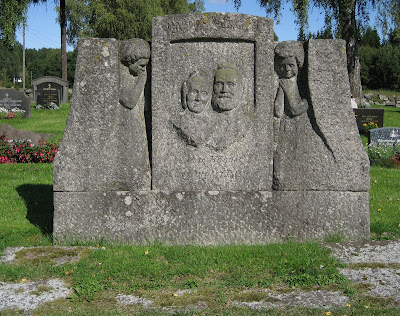

 Once again, I am struck by a sense of absolute gratitude for being here, now, doing this: and as well, for all of the help, good will and friendship that’s been offered me. I would never have come so far in my efforts to locate past and present family, to learn their stories and to piece together our history without it.
 I've been keeping a little secret...that all started with the little walk I took out to Rekkevik and the silly little note I left hoping to make contact and find family...that very evening I had a response! I got an email from a man named Kai, who said he was the husband of my 3rd cousin once removed, Marthe (Tolstrup) Strøem. It turns out that the houses I found belong to descendants of Paul Hermann Tolstrup – Magnus’s youngest brother and the only one who stayed in Norway. Over an exchange of emails, Kai and I made arrangements for me to come out to Rekkevik again - but this time to meet the family. He told me that he'd read my blog and was surprised to see a picture of his house! (theirs is the big house I photographed -brand new, actually – but built in a traditional style). The little house next door belongs to Ruth Eli Tolstrup, born in 1920, the youngest daughter of Paul Hermann – which would make her my mother's age, but my grandfather's 1st cousin. She is the oldest living relative on that side of the family and keeper of all the family stories, photos, papers and memories. Kai wrote to me that Ruth wanted to find some old photos to show me and also wanted to get someone to come during my visit to act as translator – as I can’t yet speak Norwegian and she doesn’t speak any English. Arrangements were made for me to come to meet Ruth at her house on Friday at 4:30pm and then we’d all have dinner at Kai and Marthe’s house at 6. I could barely contain my excitement.
 I knocked on the door and Ruth answered. Kari, who is her neice and daughter of another of Paul's children, Rakel, (mentioned on that infamous scrap of paper, Dave) was also there. We started to chat and at first they were most curious to know about people in some photos they had from America. Mostly they were Magnus and Louise, Harriet and Doris - there were none of anybody I knew very well - Nana and Grampa, Mum or Uncle David. I really wished I could have told them more, but I didn't know all that much. One picture, though,- looked like it might have been taken on front steps of 44 Noble St. I asked Kari about Paul Hermann's descendants and she told me he had 10 (!) children - Paul born in 1910, Waldemar, 1912, Dagmar 1913 - 1958, Borghild 1915-18, Grethe 1918, Rakel 1920 -1987, Hangry 1922 - 1989, Magnus 1925 - 1982, Marthe 1927 -1993 and Ruth Eli. (Don't worry Dave, I have more specific details about spouses and children, too). Then, Ruth brought out some more photos and some letters: These were photos of Magnus and Louise - probably when they were first married and one of Mathias as an older man.
  But the letter! It was from Magnus to Paul, dated Oct 1888 (about 3 1/2 months after he arrived in Boston)! Kari translated it and it told about his voyage (particularly about the food), commnted on news about a neighbour, gave advice for Valdemar's journey (So Magnus must have gone first, after all) and tells a bit about his new life. He also talks about sending home money - so he must have trid to help the family as he could. I knew David would be desperate to see it - and even felt a little guilty that I was getting to see it without him...so I asked if I could photograph the photos and letter. So, here they are Dave...especially for you.
 After a while, Kari asked me if I'd like to go to the Tjølling Kirke to see where Paul Hermann, his wife Hanna and their sons Hangry and Magnus (and as it turns out, Magnus and Grethe Nikoline, as well) are buried. Tjølling had been a place I had really wanted to visit and so said yes and of we went. As we were driving we talked more and I asked Kari if Magnus had ever lived in Tjølling (as the records seemed t say) she said no - always Rekkevik, but had gone to church in Tjølling, so that's why he's sometimes listed there. It seemed a long way - they used to walk it every Sunday - but Kari said they had no doubt cut through the fields and taken a much more direct route. The church was quite stunning - it dates, I think to the 11th century - which is kind of hard to fathom when you grow up in the US or Australia. I took some photos and we headed back.
 Ruth then brought out some old papers - shipping manifests, crew lists, commissions and provision lists for ships Magnus captained.
  She had an amazing amount of stuff - but she saved the best for last: when they started to build Marthe and Kai's and Ruth's new houses, they tore down the old house that had stood between them. Under the floorboards they found an old school lesson book belonging toKristen Tolstrup, dated 1765 and referencing Salling (an old term for Denmark)! Yes Dave...here are the pictures. I really couldn't imagine the visit getting any better...
 Then it was on to Marthe and Kai's house for dinner. Elin (Ruth's daughter, Marthe's mother and my 2nd cousin once removed?) and her husband Bjørn and Marthe and Kai's 2 children Emil (6 and about to start school!) and Emma 2 were waiting. I introduced myself all around and Elin asked what had brought me to Larvik and I said, I came to find all of you. Then she asked how I'd found them and I said that Dave had told me the family came from Rekkevik, so I looked on google maps to find Rekkevik and saw there was a street named Tolstrupveien...and figured it was a good place to start...then when I saw the mailbox with Magnus Tolstrup on it....I had to leave a note. She seemed flabberghasted and in fact asked me a couple more ties over the course of the evening if I'd really only come there to find them and if I'd really found them by walking down their street...the answer was always 'yes' and she'd get this big grin, shake her head and look pretty amazed (I'm pretty amazed, too!) The evening was fantastic...warm and connected. I could sense a growing interest in some of the others - especially Kari - about the family history and I showed then the work Dave has done on Ancestry.com.
 Marthe, Kai and Emma (Hei Kai and Marthe, I need good photos of Marthe's father and Emil!)
 So Larvik family, if you read this... I'm just so grateful that I've had the chance to meet you. Thank you for your kindness, your interest and warmth. I promise to keep in touch and I'll be in Boston at the end of August - so keep a look out - I'll be posting photos of the Boston Tolstrups soon!


 Posts
Posts

